
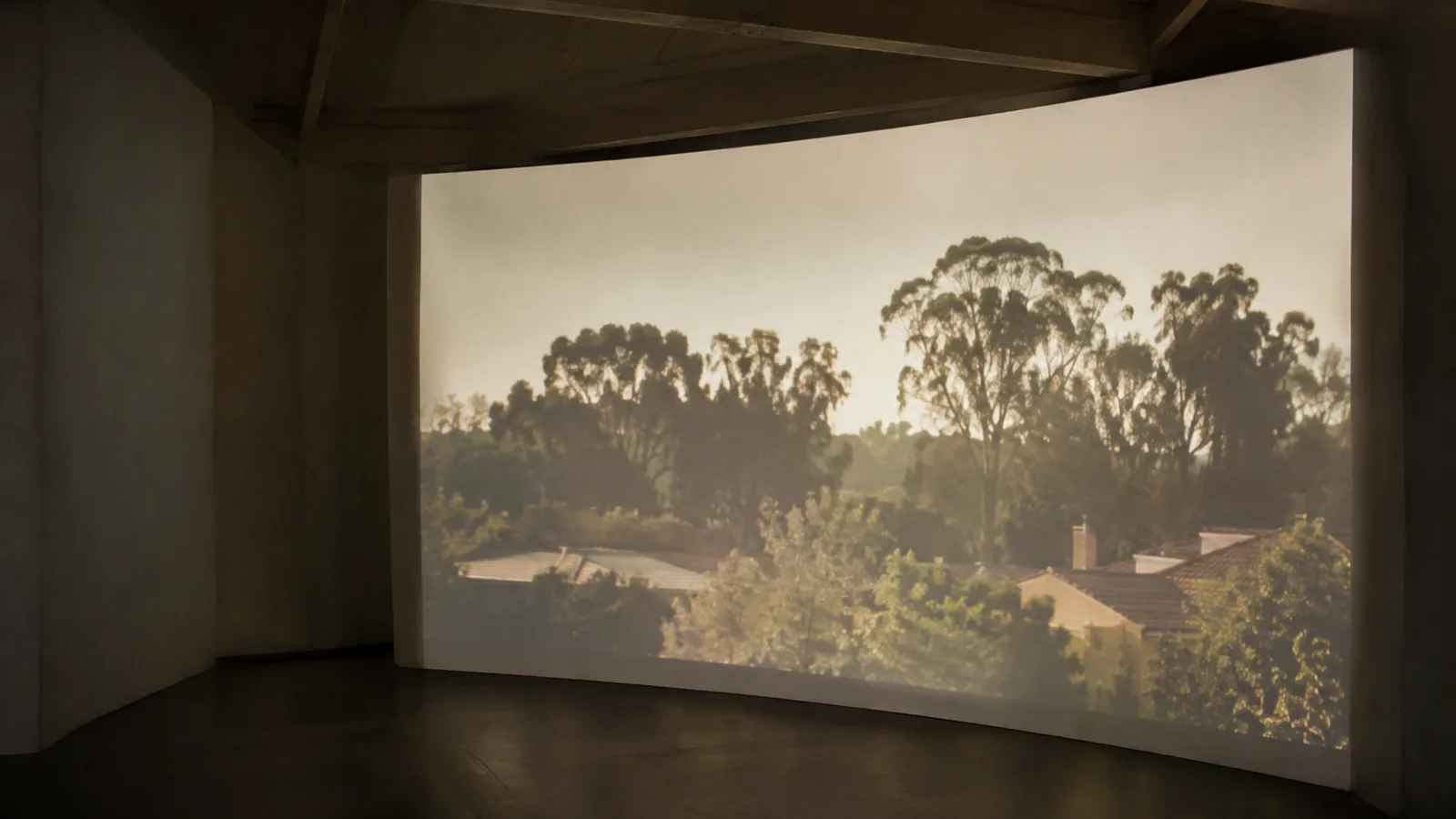
On a clear day at Greenwich, the view downhill gives you a direct line from the park towards the Queen’s House and the Thames. The Royal Observatory’s camera obscura offered a second way to look at that landscape. According to Royal Museums Greenwich, it used lenses and sunlight to show the view in real time inside. The Observatory is now temporarily closed. The museum’s closure notice gives 2 November 2026 as the start of the whole-site closure for the First Light transformation. The view and the optical principle remain a way to understand what the instrument did, even while the room itself is unavailable. Royal Museums Greenwich, description of the camera obscura · Royal Museums Greenwich, closure dates
What makes the instrument interesting is the difference between going to a viewpoint and being shown a moving image of it. In the park you choose where to look, and your eyes adjust as you move from the sky to a building. In a camera obscura, a piece of the view appears on a surface. Its boundary is apparent, its brightness depends on the light admitted, and the rest of the room has to stay dark enough for the picture to show. A visitor can watch the same scene as someone beside them and point to a detail that has a position in the image. That is an ordinary experience with a screen today. Here the image is made directly by light from outside.
The dark room is part of the instrument
Start with the simplest version. Make a small hole in one side of an otherwise dark box and put a translucent surface opposite it. In ordinary daylight, light from one direction passes through the hole and reaches one region of the surface. Light from another direction reaches another region. Because the paths cross at the aperture, the top and bottom of the scene exchange places in a basic pinhole projection, as do left and right. The hole makes an image possible by restricting which rays reach each point. Without that restriction, light from many parts of the scene would overlap too freely to give a clear picture. The Schools’ Observatory’s pinhole viewer activity shows a working version of that arrangement. The Schools’ Observatory, Pinhole Viewer
A larger hole admits more light, but it also permits a wider spread of rays from each point of the scene. In a simple viewer that can make the projection brighter and less distinct. A very small hole can make the image hard to see. A lens gives a different way to gather and direct light, and it can bring a chosen distance into focus on a screen. The trade-off is a reason to pay attention to the difference between the box you can make yourself and the installation described at Greenwich. A viewer made from a box illustrates the same relationship between an aperture, a dark space and a surface. It does not establish the exact optical layout, image orientation or controls used in a particular historic instrument.
Darkness changes the visibility of the projection. Try to see the faint image while light is falling directly on the viewing surface and you may miss the detail that emerges when you shade it. This is a comparison between the light carrying the view and stray light arriving from elsewhere. Walking into a darkened room also gives your eyes a different scene to adapt to. That is why someone who has been watching for a while may find a shape that a new arrival has yet to see. In a small viewer, shielding the viewing area can be a more useful first step than immediately changing the hole or shifting the screen.
The projected picture is live in a very particular sense. If someone walks across the distant ground in view, their movement appears in the projection while light from the scene is entering the instrument. If a cloud covers the sun, the balance of light can change. Nothing in a basic box stores a frame. When you remove the screen or block the hole, the image disappears. A photograph of the projection records one moment in that process. It can show what happened, but a still image cannot demonstrate the continuous link between the movement outside and the movement on the surface. That link is a good thing to look for in any functioning camera obscura.
The view from the hill has its own geometry
Royal Museums Greenwich’s description points to the Queen’s House and the Thames. Those references make the optics easier to imagine. A pale building can offer a large shape against darker ground. A river offers change, through moving vessels, changing reflections and a changing edge of light. Looking from the park, you may be able to see both across a wide field of view. A projected image frames a part of that field. A change of framing can make a distant crossing or a shift of light much easier to notice, precisely because you no longer have the whole panorama competing for attention. Royal Museums Greenwich, family itinerary and description of the view
Try a simple comparison in the park if you are there and access permits. Choose one fixed feature on the ground below and another farther away. Look first without a frame. Then hold your hands or a plain card frame at a comfortable distance so that the two features are isolated from some of their surroundings. The card does not make a projection. It does let you see what a limit to the field changes. A boat that was incidental in the panorama may become the one moving thing inside the frame. The same exercise works with architecture. Removing nearby buildings can clarify the silhouette of a roof and obscure how it belongs to the street.
Then change the viewpoint if there is a public path that allows it. A feature close to you may shift sideways against a feature farther away. A roof that partly covered another from one position may reveal it from the next. This is different from cutting the view down to a smaller rectangle while standing still. The comparison helps explain why two photographs of the same part of Greenwich can disagree about which buildings appear beside each other. An optical instrument fixed at a site has a viewpoint built into it. Its image is evidence of what could be seen from there under particular conditions, with a chosen field and a means of projection.
Historical views need the same care. Royal Museums Greenwich catalogues an 1824 aquatint of Flamsteed House. Its record notes that projections on one cupola may relate to its use as a camera obscura at the time, while pointing out features of the print that do not accurately represent the building. The qualification is part of the evidence. An image can be useful for investigating the history of the site and still require comparison with other records. For the camera obscura, the catalogue offers a historical question to follow rather than a drawing from which to reconstruct an optical instrument. Royal Museums Greenwich, collection record for the 1824 Flamsteed House aquatint
Make a comparison that shows where the image comes from
If you build a small viewer, start with a bright outdoor subject of ordinary daylight viewed from a shaded position. Choose a building or a tree with a clear outline. Never point a viewer or lens at the sun or look towards the sun through it. Build and use the viewer according to the Schools’ Observatory’s activity. Hold the aperture still and look for the change on the screen when someone passes across the scene or a branch moves. If the picture is faint, first reduce light reaching the viewing surface from your side. If you change several parts of the apparatus at once, it becomes much harder to tell what improved it. The Schools’ Observatory, pinhole viewer construction and observation
A box lets you make a second comparison that the park cannot. After noting the projected position of an object, turn slightly and watch what moves onto or out of the screen. You can draw the outline of the screen and mark two objects on it. Then draw the same two objects as they appear when you look at the scene directly from the same position. The difference may be easier to grasp through those two sketches than through a verbal description of the rays. If you want to discuss focus or brightness as well, keep the subject and position constant while you change only one part of the viewer. That separates the optics from changes in the scene itself.
There is a useful link to photography here. A camera may also put a framed optical image onto a light-sensitive surface. The subsequent file is a record of that image for a particular exposure and set of processing choices. A live camera obscura gives you a chance to watch before anything is recorded. You can ask what the instrument gathers, what the room or screen makes visible, and what a photographer would choose to retain. Those questions are still useful when the capture is digital. A visible view, the image formed by an optical system and the image people later see are stages in a process.
Planning around the First Light closure
The Observatory closure changes a November itinerary. Use the closure page for the current position instead of relying on older family itineraries that describe the instrument. The First Light project page distinguishes planned milestones for parts of the site from completion of the wider project. In particular, it gives summer 2027 as the plan for the Meridian Courtyard and spring 2028 for completion of the project. Those statements do not give a separate confirmed reopening date for the camera obscura. If it is the reason for a future trip, check for a specific update from the operator before booking. Royal Museums Greenwich, closure notices · Royal Museums Greenwich, First Light visitor information
For a visit during the closure, Royal Museums Greenwich directs visitors towards astronomy activities at the National Maritime Museum. The current visitor pages are the place to check which events are available on the day. A walk to a publicly accessible viewpoint, time with the buildings below and a small optical experiment at home make a different visit from entering the original room. They can still bring the same question into focus. When a landscape is turned into an image on a surface, which pieces of it become easier to see, and which pieces fall outside the frame? Royal Museums Greenwich, visitor information during the closure
The cover is an illustration of a generic projection room. The museum’s collection and visitor pages provide identifiable material about Greenwich itself. From the park, the relationship between the hill, the buildings and the river is already there to observe. In the dark room, those places used to come together as light on a surface, with movement that belonged to the same moment outside. Once you have seen even a modest projection from a box, it is easier to imagine what a shared optical view can do. It gives a roomful of people a small part of the world to watch together.