
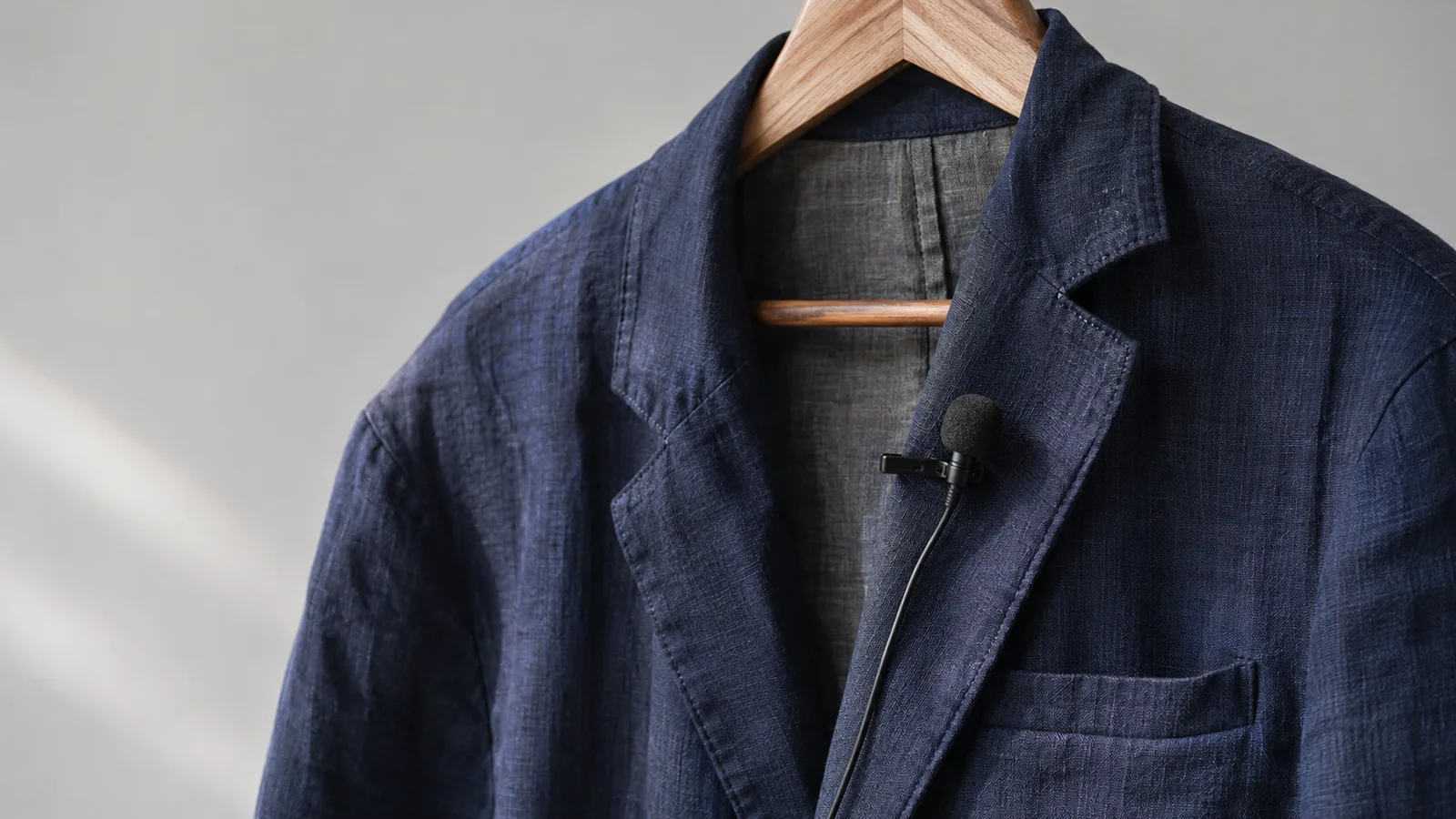
A guest settles into a chair, answers the first question clearly and then leans forward. The next sentence arrives with a scratch that seems much louder than the movement looked. Nothing has failed electronically. A jacket has moved against a microphone, or a cable has carried a small tug into the recording. For an interview editor, that can be a more consequential problem than whether the camera was perfectly level.
Small microphones encourage a particular misunderstanding. Because they look unobtrusive, they can appear to need very little attention. In practice, putting a microphone on somebody introduces clothing, posture, personal space and changing movement into the sound setup. Those are production decisions, even when one person is doing every job. The useful question is not simply where the clip will fit. It is what the microphone will hear once the conversation becomes a conversation.
Consider a hypothetical interview with a local illustrator at a studio table. The guest wears a loose overshirt, frequently turns towards a sketchbook and uses both hands to explain a process. A tidy microphone position chosen while the guest faces the camera may sound very different during the explanation. The test needs to include those actions. Asking somebody to sit motionless and count to ten checks a much smaller problem than the recording you actually intend to make.
The position belongs to a moving person
RØDE’s practical guidance connects mounting position with distance from the mouth and warns against contact with other clothing. That is a useful starting point for planning a visible clip position. It does not remove the need to listen to the particular voice, garment and movement in front of you. The examples here describe an approach to testing, rather than results from a product comparison. RØDE’s lavalier guide
A position should remain reasonably consistent through the actions that matter. If the guest repeatedly turns towards a person sitting on one side, record that turn before deciding that the setup is finished. If they will demonstrate something while standing, include the transition from sitting to standing. This is also an opportunity to arrange the conversation so that the important movement is comfortable, visible and audible, instead of asking the guest to remember an unnatural set of restrictions.
Do not treat a distance recommendation as a substitute for identifying the microphone. A small capsule might be omnidirectional or directional. Countryman’s B2D instructions, for example, specify positioning and orientation for that directional model. That model-specific instruction is a reason to read the manual for the equipment you have, rather than copy an orientation from a photograph of a different lavalier. Countryman’s B2D manual
In the imagined studio interview, try an exposed clip on a stable edge of the overshirt before attempting concealment. Let the guest look down at the sketchbook and back towards the interviewer. Listen for a changing voice tone as well as scratches. A clear difference when the head turns may suggest another mounting position or a change to where the interviewer sits. You can solve part of the recording problem by arranging the conversation more thoughtfully.
Clothing is an active part of the setup
There are several different noises that can be described casually as rustle. Fabric can touch the capsule. Two layers can rub near it. A necklace can knock against a clip. A cable can be pulled when an arm moves. These are different physical events, so they deserve separate tests. Moving everything at once may produce an improvement without showing which change mattered, leaving you unable to reproduce it after a break.
Ask the guest to repeat one ordinary movement while you listen. If the scratch appears with a shoulder turn, inspect the path of the garment around that movement. If it happens only when a hand reaches across the body, look for a cable or loose layer being caught. The aim is to connect a sound with an action. That connection is often more useful than trying to describe the noise through a long list of audio adjectives.
A hidden microphone changes the visual result but adds surfaces around the capsule. It can be appropriate when appearance matters to the production. It also needs a test of its own. A concealed position that is quiet when somebody breathes gently may fail when they laugh or bend. Avoid making concealment the automatic measure of professionalism. The appropriate position is one that supports the actual scene and respects the person’s comfort.
Any attachment involving clothing or the body needs an explanation and consent. Describe where you would like the microphone and allow the guest to fit it themselves if that is more comfortable. Make adjustments through conversation, not by reaching unexpectedly. This is especially important for a small production where no separate sound professional has been introduced. A calm fitting process can prevent both an uncomfortable encounter and a rushed, poorly tested mount.
Check the route all the way to the recorder
A microphone can be well positioned and still produce an unusable file if the connection or recording path is wrong. Follow the signal from the capsule to the device that actually saves it. Identify the connector, any adapter, the selected input and the file being written. Similar-looking plugs and ports are not sufficient evidence that a particular combination is compatible. Confirm that through the relevant equipment documentation.
Make a short recording, stop it and play that saved recording back. Hearing sound during setup is useful, but a saved test answers a different question. It shows that the intended device and application produced a file you can open. In a hypothetical phone-based workflow, this may reveal that an application used the built-in microphone instead of the accessory. Discovering that after thirty seconds is much cheaper than discovering it after the guest leaves.
Where more than one microphone is present, identify each one in the test. Speak near one source at a time and check the resulting channels. This prevents a reassuring meter movement from concealing the fact that the wrong microphone is active. Keep any channel separation you need for editing, and establish which file contains it. The edit should not depend on remembering a routing decision that nobody wrote down.
Wireless equipment adds another part of the route. Check the receiver’s connection, the transmitter’s status and the recording device as separate things. A healthy transmitter display does not by itself prove that the camera has recorded the signal. If a device supports an additional recording, verify how that feature works and how you would retrieve the file. The existence of a feature on a specification page is not a completed backup procedure.
A realistic rehearsal takes less time than a repair
For the studio example, the rehearsal can follow a miniature version of the interview. Ask the guest a real opening question, let them reach for the sketchbook, then invite them to explain one detail. Listen during the movement, and play the file back afterwards. This gives you information about conversational level, interruptions, clothing, posture and the relation between the microphone and the scene. It also helps the guest understand the pace of the recording.
Include an expressive moment without asking for a performance. Someone explaining a frustrating commission may naturally speak more strongly than when introducing their name. Leave room for that variation when setting the recording level. Do not use the quietest possible rehearsal as the sole reference for a conversation expected to contain laughter and emphasis. The test should represent the range you reasonably anticipate, while recognising that the actual interview can still surprise you.
Listen through headphones at a sensible monitoring level. If the room itself is loud, turning monitoring up indefinitely can make judgement uncomfortable and unreliable. Move the test to a quieter moment where possible, or inspect the saved file in a more suitable environment before committing to a long session. Monitoring is there to support decisions. It is not evidence that you should accept every location merely because the equipment produces a signal.
A brief note can make a break much safer. Record which input was used, where the microphone sat and whether a particular movement created noise. You do not need an elaborate engineering log for a short interview. You do need enough information to restore the setup after lunch or after moving to another room. A photograph of the external clip position can help, provided the person is comfortable with that photograph and its use.
The room can change the mounting decision
Imagine moving the interview from the studio table to an open doorway. The position that worked indoors now sits near moving air and a busier street. Repeat the test in the new place. Listen for the difference between a steady background and bursts that cover particular words. Those two problems can suggest different choices, including waiting for a vehicle to pass, closing the door or choosing a sheltered position for the conversation.
Use wind protection intended for the microphone and the situation, following the manufacturer’s fitting instructions. Check that it remains secure through the movements you rehearsed. A loose accessory introduces another object that can move or rub. If changing the protection changes how visible the microphone is, resolve that with the camera framing before recording the complete answer. Sound and picture need to describe the same workable setup.
Room noise also deserves a deliberate comparison. Record the guest in the intended position, then try a plausible alternative location without changing every recording setting. Listen to both files at comparable playback levels. This separates a location decision from a louder-playback preference. A beautiful-looking corner may make an interview harder to follow than a less striking wall a few steps away. Hearing that difference gives the producer something concrete to weigh against the picture.
Listen while the story develops
The setup is not finished forever when the first question begins. A guest may remove a jacket, shift the transmitter while sitting down or move the microphone while adjusting a collar. Keep listening for a change that coincides with one of those actions. If a problem starts, stop at a natural pause and explain it plainly. Repeating one answer while its meaning is still fresh is generally easier than reconstructing a whole conversation later.
An interruption should serve the interview, rather than make the guest anxious about every movement. Say that the microphone caught a noise and that you would like the last thought again. Avoid turning a technical correction into a judgement about how the person speaks. For the editor, a short pause before the repeated answer also creates a useful boundary. The replacement becomes easier to identify without searching through several nearly identical fragments.
Editing tools may reduce some unwanted sound, but overlapping speech and garment noise can be difficult to separate convincingly. Treat repair as a question to assess from the actual file. Do not promise that an automated feature will recover any damaged sentence. Where a passage carries a name, a qualification or the central point of the interview, understandable words matter more than maintaining the illusion of an uninterrupted take.
Before the guest leaves, confirm that the important files are present and playable. Keep the original recording, and make subsequent editing decisions on working copies. If you have a second recording, establish how it corresponds to the main one before assuming it solves a problem. A second file with an uncertain start point or missing section is something to investigate, not a guarantee. The small microphone has done its job when the person can move and speak naturally, and the resulting recording preserves what they meant to say.