
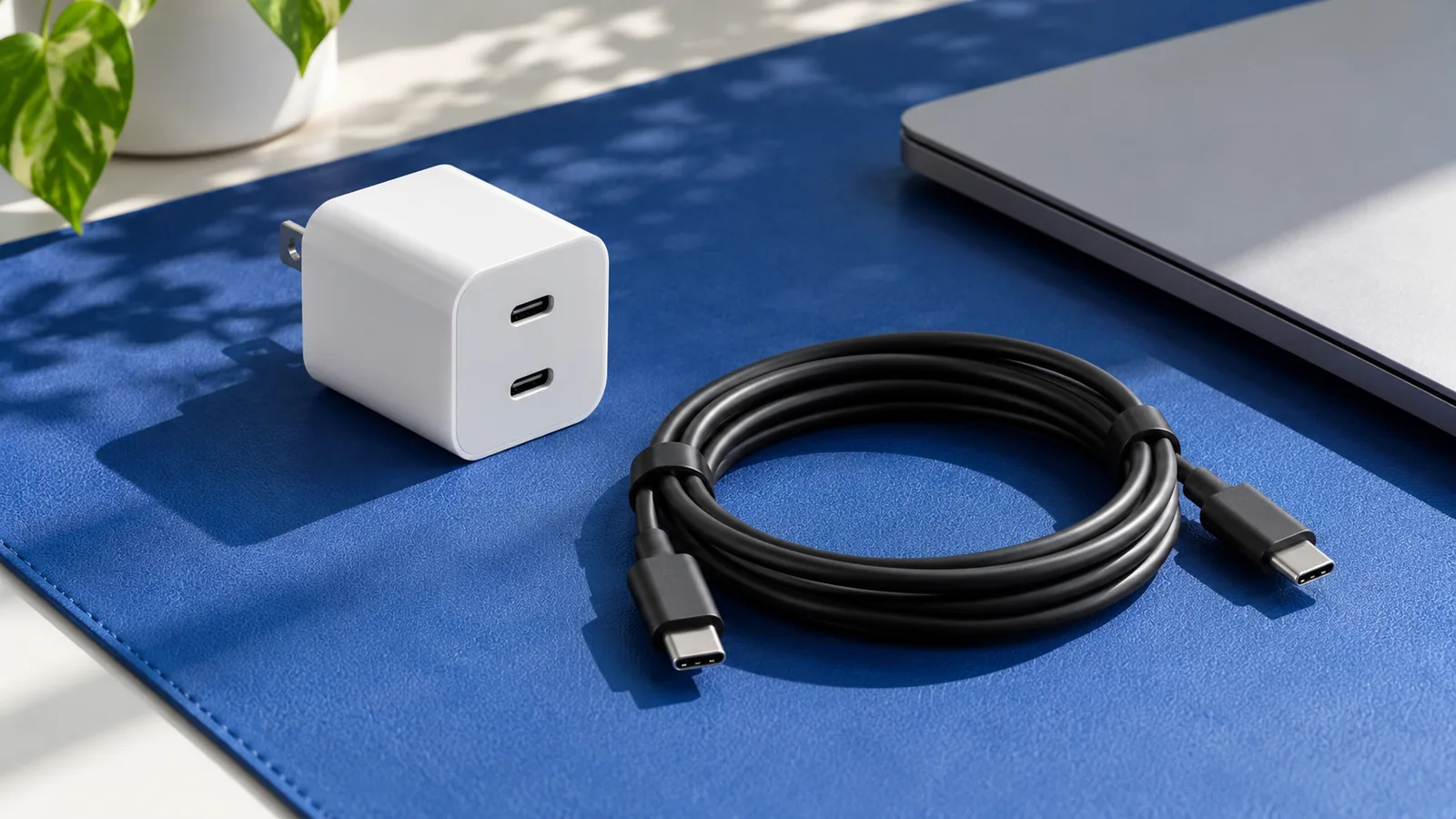
The smallest charger in the bag can create the largest argument with the rest of the equipment. A phone appears to charge normally, a laptop shows a charging symbol but gains little battery during work, and plugging in a second device changes the arrangement again. Every connector fits. That is useful, but it is not the whole specification. The practical question for a traveller is whether a particular combination of charger, cable and devices can support the day they actually intend to have.
Europe’s common charging rules make that question easier to approach, without making it disappear. According to the European Commission’s explanation of the common charger, the requirements have applied to the listed categories of portable devices since December 2024 and to laptops since 28 April 2026. A shared connection is an important improvement. It does not mean that every item already owned must be replaced, or that any charger with the right-shaped socket will deliver the same experience with every laptop.
Start with the machine that makes the greatest demand
Packing often begins with accessories: find a compact adapter, count its ports and assume the devices can be arranged around it. Reversing that process is more revealing. Identify the device that will be hardest to keep working and read its manufacturer’s charging guidance. For a person travelling with a laptop, that may be the laptop rather than the phone. The relevant model matters more than a general impression that a brand is easy or difficult to charge.
Apple’s guidance on using a power adapter with a Mac, for example, says that a Mac charging through USB-C can use an adapter or display supporting USB Power Delivery, while recommending adequate wattage for the best experience. This is guidance for those machines, rather than a specification for every laptop. Its wider practical lesson is to match the charger to the device’s documented requirements instead of treating a fitting connector as the end of the investigation.
A useful packing note records the actual device model and the requirements relevant to it. There is no need to memorise a catalogue of electrical terminology. The note exists so that two products can be compared against the same need. A recommendation made for a different computer may still be interesting, but it should not silently become evidence for the one being packed. This distinction is especially useful when equipment has been borrowed from an office or shared household.
Consider a hypothetical traveller who plans to edit photographs for several hours in a rented room. The right comparison is not simply whether the laptop charges when closed overnight. It is whether the documented charging arrangement supports the intended pattern of use. Someone who only opens the same machine briefly to retrieve documents may have a different practical requirement. Neither traveller is wrong; they are asking their equipment to do different jobs.
A large number on the box needs a sentence around it
A charger’s headline power rating is only informative when the buyer understands what it describes. With a multiport product, check the manufacturer’s allocation information rather than assuming that the largest number applies independently to every socket. The specification should explain the combinations that matter: one device connected, the laptop and phone together, or several devices at the same time. If that explanation cannot be found, there is an unresolved question rather than a reason to guess.
This is where a small hypothetical example becomes useful. Imagine a charger bought because its headline rating appears suitable for a laptop. The traveller then connects a phone to another port while exporting a project. Before relying on that arrangement, they should know what the manufacturer specifies for that combination. The example does not predict a failure for every multiport charger. It shows why the intended combination, rather than a single isolated figure, belongs in the comparison.
The same care applies to a port that looks convenient because it is nearest the edge of the table. Products may document their outputs differently. A photograph showing several identical sockets is not a substitute for the output table. Taking a brief note of the intended arrangement can make the equipment easier to use later, particularly for a group sharing one charger. It is much less frustrating to understand the arrangement at home than while everyone is waiting to leave.
There is also a distinction between a practical compromise and an unexplained problem. A traveller may deliberately charge devices one after another to save space. That can be perfectly workable if the timetable allows it. The difficulty begins when simultaneous charging was assumed, but the packing plan only works sequentially. The product has not necessarily broken; the use case was never properly described. Making that description explicit often prevents an unnecessary purchase.
The cable belongs in the decision
A cable is easy to treat as a spare length of wire, especially when several similar black or white cables collect in a drawer. For charging, the sensible approach is to keep a cable whose documented suitability matches the chosen arrangement. If the device or adapter maker specifies particular requirements, follow those requirements. A connector that enters the socket is a physical check, not a complete assessment of the cable’s intended use.
Labelling can be modest. A small removable marker or a separate pouch can distinguish the cable selected for the laptop from one carried for another purpose. This does not create an electrical capability that the cable lacks; it preserves information already verified. It also helps when companions pack up a shared room. A carefully chosen arrangement is less useful if its parts are mixed with unknown accessories at the first stop.
Condition matters as much as organisation. An accessory with visible damage should not become the travel backup simply because it would otherwise be left at home. Questions about damage or safe use belong with the manufacturer or an appropriate qualified service, not a homemade repair intended to survive one more journey. A packing guide should not turn an uncertain cable into a technical experiment conducted beside a hotel bed.
The backup decision can then be proportionate. Carrying a second suitable cable may solve a different problem from carrying another adapter. Losing a cable, lacking an outlet and discovering incompatible equipment are separate scenarios. It is unnecessary to pack every conceivable redundancy, but it is helpful to know which interruption the spare is intended to address. Otherwise the bag becomes heavier without becoming more dependable.
The room has a charging layout too
Even a well-matched set of accessories can be awkward in the room where it is used. The available outlet may be far from the work surface, partly obstructed or needed for another appliance. These are practical possibilities, not promises about a particular property. Looking at the room description and asking a precise question can be worthwhile when reliable desk work is essential to the trip. A vague assurance that electricity is available tells a remote worker very little.
Travelling between countries adds the need to check plug compatibility and the electrical ratings of the equipment. A USB-C connector on the device side does not resolve what is needed at the wall. Follow the adapter manufacturer’s stated input specifications and use appropriate, compliant accessories for the destination. Avoid treating the purchase of a plug-shaped travel accessory as proof that every electrical question has been answered.
Where work is important, plan the charging sequence around real transitions. A device left charging in the accommodation cannot also be used to navigate outside. A laptop packed immediately after a meeting may have had less charging time than expected. The practical schedule includes checkout, transport and access to the room, rather than an uninterrupted imaginary night beside a perfect outlet. Small constraints become manageable when they are visible in advance.
Sharing changes the calculation again. Two people who each plan to use the same charger for most of the evening do not have two independent charging plans. They have one shared resource with competing demands. Agreeing what will be connected, and when, may be enough. If it is not, that is a concrete reason to adjust the equipment. It is more informative than deciding that a charger is too small simply because it has fewer ports than the group has devices.
Test the arrangement, rather than the unboxing
A useful check at home resembles an ordinary working session. Connect the intended devices using the intended cables and follow the manufacturer’s guidance. Confirm that the chosen arrangement behaves as expected before it becomes essential away from home. This is a practical familiarisation exercise, not a laboratory test, a safety certification or a claim that the equipment will perform identically in every circumstance.
It is worth checking both the simple and the shared arrangement. If the travel plan involves charging a laptop alone during a meeting, and several smaller devices afterwards, those are separate uses to understand. A brief successful connection does not answer every question about sustained work. Equally, a slow-looking moment should not immediately be turned into a diagnosis. The device’s own guidance and status information are better starting points than an unsupported conclusion about a faulty product.
Keep the observation modest and specific. One can record that a certain arrangement was used with a particular machine in a particular session. That does not justify declaring it the best charger for all creators or all travellers. For an individual packing decision, however, the observation can be enough to reveal a missing cable, an inconvenient layout or a need to read the output information more carefully. Those are useful findings without an inflated product review.
If a problem remains unclear, contact the relevant manufacturer with the model numbers and the combination used. Saying that a charger does not work provides less information than describing which port, cable and device were involved. Keep sensitive account information out of unnecessary screenshots. The aim is to make the technical question answerable, not to collect a large archive of pictures that still leaves the arrangement ambiguous.
There is a useful distinction between a permanent equipment change and a travel-only adjustment. A short trip may require a different cable length or a shared charging sequence, while the everyday setup remains suitable. Keeping a brief note of the reason for the adjustment prevents a temporary inconvenience from becoming an unnecessary replacement of everything on the desk. On returning home, the traveller can assess whether the extra item solved the problem it was bought for. That is a more grounded evaluation than deciding that a product was essential merely because it was carried throughout the journey.
Common charging should reduce replacement, not create another shopping race
The attraction of a common connector is partly the chance to keep useful accessories in service. A traveller does not need a new charger merely because a new rule has become applicable to products in the market. Existing equipment should be assessed on its own documented suitability and condition. Replacing everything can recreate the same drawer of redundant accessories that a shared connection is meant to make less necessary.
An economical decision may therefore begin by sorting what is already available. Identify complete combinations that can be understood and used reliably. Separate unknown or unsuitable items instead of allowing their similar appearance to blur the distinction. Only then look for the missing part. This makes a recommendation from a shop or manufacturer easier to assess because the question is specific: a suitable cable, a compatible adapter or a charging arrangement for a known device.
The most useful travel charger is not defined by the fewest grams, the greatest number of ports or the largest number printed in an advertisement. It is the one whose documented capabilities match the devices and whose practical arrangement matches the day. USB-C brings the pieces closer together. A little attention to those pieces is what turns a common port into a simpler journey.